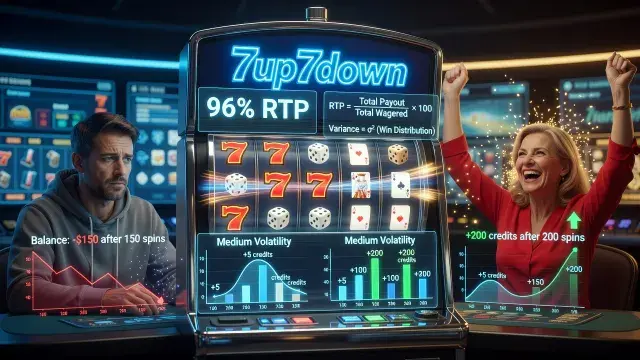

A slot with a 96% return figure still loses money for the vast majority of players who spend a session on it. That single fact confuses more people than any other statistic in online gambling, and it sits at the center of every conversation about 7up7down RTP. The number looks generous on paper, yet the lived experience of spinning the reels rarely matches the theoretical promise printed in the paytable.
7up7down draws attention precisely because its mechanics are simple enough to expose how return percentages actually behave over thousands of spins rather than a handful of lucky ones. The game strips away complex bonus rounds and multi-layered features, leaving a cleaner view of how 7up7down slot RTP translates into real outcomes. Players researching the game's payout behavior often land on detailed breakdowns such as the one available through 7up7down rtp, where the percentage figures are laid out alongside variance data. Understanding that relationship between RTP and variance changes how a person approaches bankroll management, session length, and expectations entirely.
What follows is a grounded explanation of what the 7up7down RTP percentage actually measures, why variance matters just as much as the headline number, and how the two combine to shape the real return to player experience across different playing styles.
What RTP Actually Means in 7up7down
Return to Player is a theoretical figure calculated across millions of simulated spins, not a promise attached to any single session. When a slot advertises a 7up7down return to player rate, that number reflects the average amount paid back to players over the long run, expressed as a percentage of total wagers. A 96% RTP does not mean a player gets back 96 cents of every dollar staked in a given hour. It means that across the entire lifetime of the game, spread across every player who has ever spun it, the average payout settles near that mark.
The Mathematical Basis of RTP
RTP is derived from the game's paytable and the probability of landing each combination. Developers run exhaustive calculations, sometimes supplemented by simulation software, to determine the exact percentage before a game is certified for release. Every symbol, every payline, and every special feature contributes a fraction of a percentage point to the final figure.
Why RTP Is a Long-Term Average, Not a Short-Term Guarantee
Short sessions are dominated by variance, not by the RTP figure. A player can lose steadily for hours on a 97% RTP game or double their balance in twenty spins on a 92% RTP game. The percentage only becomes meaningful when the sample size grows large enough to smooth out the random swings.
How 7up7down's RTP Compares to Industry Standards
Most licensed online slots fall within a range of roughly 92% to 97%. 7up7down sits comfortably within that band, positioning it neither as an outlier with unusually poor returns nor as an exceptional payer. Its simplicity as a game format tends to align with mid-to-high RTP figures, since fewer complex bonus mechanics typically mean fewer opportunities for developers to skew the math toward the house.
Breaking Down the 7up7down RTP Percentage
The specific percentage attached to 7up7down matters less in isolation than it does in context. A single number without variance data tells only half the story, but it remains the starting point for any serious evaluation of the game's payout structure.
Where the Official Percentage Comes From
Licensed slot developers submit their games to independent testing labs before release. These labs verify that the stated RTP matches the actual mathematical model of the game, checking the random number generator and the paytable against the advertised figure. This certification process is what allows a player to trust that the published 7up7down RTP percentage isn't marketing spin.
Fixed vs. Variable RTP Configurations
Some slot titles ship with multiple RTP configurations that operators can select from, meaning the same game might return 95% on one platform and 97% on another. Players should confirm which configuration a specific casino is running rather than assuming a single universal figure applies everywhere the game appears.
Reading RTP in Context of Bet Size and Paylines
RTP percentages are usually calculated at a base bet level and assume full participation across all active paylines. Adjusting bet size or disabling certain lines can shift the effective return slightly, since some features or bonus triggers may only activate at specific wager thresholds.
- Confirm the RTP percentage listed by the specific operator hosting the game
- Check whether bonus buy or feature-based options carry a different RTP than the base game
- Understand that promotional RTP boosts, when offered, are typically temporary and clearly disclosed
Understanding 7up7down RTP Variance
Variance, sometimes labeled volatility, describes how payouts are distributed rather than how large they are on average. Two games can share an identical RTP of 96% while behaving completely differently at the table. One might pay small, frequent wins; the other might stay quiet for long stretches before delivering a substantial payout. 7up7down RTP variance sits at the heart of what makes the game feel the way it does during actual play.
Low, Medium, and High Variance Defined
Low variance games return smaller wins frequently, keeping the balance relatively stable session to session. High variance games do the opposite: long dry spells punctuated by occasional large hits. Medium variance sits between the two, offering a blend that many casual players find comfortable.
Where 7up7down Sits on the Variance Scale
7up7down leans toward medium variance, consistent with its straightforward format and limited feature set. Wins arrive with reasonable regularity, but the game still holds back enough to create meaningful swings in balance over an extended session. This positioning makes it accessible to players who dislike the extreme drought periods associated with high-variance titles, while still offering enough unpredictability to stay engaging.
Why Variance Affects Perceived Fairness
Players often mistake a losing streak on a medium-variance game as evidence of a rigged system, when in fact it's a predictable outcome of statistical variance. Understanding this distinction prevents the common error of judging a game's fairness based on a single unlucky session rather than its verified long-term percentage.
How RTP and Variance Work Together in 7up7down
Neither RTP nor variance tells the complete story on its own. A player who only checks the percentage figure without accounting for variance is missing half the equation needed to predict how a session will actually feel.
Modeling a Typical Session
Consider a player wagering steadily over 200 spins. With a 96% 7up7down slot RTP and medium variance, the realistic outcome is a session with several small wins, one or two moderate hits, and an overall balance that trends slightly downward, consistent with the built-in house edge of 4%. The variance determines the shape of that curve, not the destination.
Why Two Players Can Have Wildly Different Results
Random number generation guarantees that no two sessions unfold identically, even under the same RTP and variance profile. This is why forum posts claiming a game "never pays" or "always pays" should be read skeptically. Individual anecdotes reflect variance, not the underlying mathematical truth of the return to player figure.
Adjusting Strategy Based on the RTP-Variance Combination
Players with smaller bankrolls generally fare better on medium or low-variance games like 7up7down, since the payout frequency helps sustain playing time. Those chasing larger, less frequent wins might find the game's variance profile too conservative and gravitate toward higher-volatility alternatives instead.
Practical Tips for Playing 7up7down With RTP in Mind
Knowing the numbers is only useful if it translates into better decisions at the table. The following practices help players apply RTP and variance knowledge in a way that actually affects outcomes.
Setting Realistic Bankroll Expectations
Given the game's return to player rate and medium variance, players should size their bankroll to withstand at least 100-150 spins without exhausting funds. This buffer allows the natural swings of variance to play out rather than ending a session prematurely during a temporary downturn.
Choosing Session Length Wisely
Shorter sessions amplify the influence of variance, while longer sessions gradually pull results closer to the theoretical RTP. Players seeking a predictable experience should plan for extended play, while those hoping for a quick high-impact win should accept that shorter sessions carry more randomness, not less risk in the mathematical sense.
Avoiding Common Misconceptions
A frequent error is assuming that a game is "due" for a win after a losing streak, or "cooling down" after a payout. Random number generators have no memory of previous spins, and the certified RTP percentage remains constant regardless of recent history.
- Track your own spin history to see how it compares to the theoretical RTP over time
- Avoid chasing losses by increasing bet size after a dry stretch
- Treat every spin as statistically independent from the last
Frequently Asked Questions
Is a higher 7up7down RTP percentage always better for players?
A higher RTP generally favors players over the long run, but it doesn't guarantee better short-term results. Variance plays an equally large role in shaping the actual playing experience, so a slightly lower RTP with favorable variance can still feel more rewarding session to session.
Does the RTP change depending on which casino offers the game?
It can, since some slot titles are released with multiple RTP configurations that operators choose between. Always check the specific RTP percentage listed by the platform you're using rather than assuming a universal figure applies everywhere.
Can betting higher amounts improve my actual return?
Bet size does not alter the underlying RTP percentage, which is a fixed mathematical property of the game. Higher bets simply mean larger swings in either direction, not a better statistical outcome.
Why did I lose money on a game with a 96% RTP?
The 96% figure is a long-term average calculated across millions of spins, not a per-session guarantee. Short-term results are governed far more by variance than by the RTP figure itself, so individual losing sessions are entirely consistent with a high RTP rating.
How is variance different from RTP in practical terms?
RTP tells you how much a game returns on average over time, while variance tells you how those returns are distributed across sessions. A game can have excellent RTP and still feel frustrating if its variance produces long stretches without a payout.
Is 7up7down suitable for players with small bankrolls?
Its medium variance profile makes it reasonably suitable for smaller bankrolls, since payouts arrive with enough frequency to sustain extended play without requiring large reserves to survive dry spells common in high-volatility games.