Japan operates more pachinko parlors than the entire United States has movie theaters. That single comparison explains why this mechanical ball game generates revenue figures that rival the country's automotive exports, despite most outsiders never having heard of it. A pachinko machine looks deceptively simple: steel balls, a vertical playing field, and a cluster of pins. Yet behind that simplicity sits a legal, cultural, and technical system that has puzzled foreign visitors for decades.
The confusion starts with a basic question - is this gambling or entertainment? Japanese law answers "entertainment," and that distinction shapes everything from parlor design to payout mechanics. Meanwhile, the game has quietly migrated online, spawning digital versions that strip away the legal gray zones and let players anywhere try the mechanics for themselves. If you're curious enough to sample a modern variant without stepping into a parlor, a crazy pachinko game available through international platforms shows how far the format has traveled from its Japanese arcade roots.
This guide breaks down the mechanics, the legal structure, the arcade culture, and the online migration of pachinko - giving you a complete picture of a game that has survived seven decades of regulatory pressure and technological change without losing its core identity.
What Pachinko Actually Is
Origins and Cultural Role in Japan
Pachinko emerged in the 1920s as a children's amusement modeled loosely on Western pinball machines called Corinth games. By the postwar years, adult versions had spread across Japan, filling a gap left by strict anti-gambling laws. Today the pachinko game occupies a strange cultural space: officially a hobby, practically a national pastime, and economically a sector that rivals major industries in scale. Parlors sit on prominent street corners in nearly every city, recognizable by their neon signage and constant mechanical noise.
Basic Mechanics: Balls, Pins, and Pockets
A player buys a supply of small steel balls and loads them into the machine. A spring-loaded handle launches balls into the playing field, where they cascade through a maze of pins, sometimes landing in scoring pockets and sometimes falling straight through to the bottom. Landing in the right pocket triggers a mechanism - often a spinning digital display - that can award a jackpot of additional balls. More balls mean more chances to win further prizes.
Why It's Classified as Amusement, Not Gambling
Japanese law prohibits cash payouts from games of chance, so pachinko parlors award prizes instead - trinkets, electronics, or tokens. Players then take those tokens to a separate, technically unaffiliated shop nearby and exchange them for cash. This "three-shop system" keeps the parlor, the exchange counter, and the wholesaler legally distinct, allowing pachinko to operate in a space adjacent to gambling without formally being gambling under Japanese statute.
How a Pachinko Machine Works
Mechanical Components Explained
Every pachinko machine relies on a dense field of brass or steel pins arranged to create unpredictable ball movement. Beneath the glass face sit tulip-shaped gates that open and close based on triggered events, along with a central digital reel that mimics a slot machine. The physical randomness from the pins combines with electronic randomness from the reel, producing outcomes that feel chaotic even though they follow programmed probability curves.
Modern Digital Integration in Machines
Contemporary machines pair analog ball movement with LCD screens showing anime characters, storylines, and bonus animations. This shift began in the 1990s and accelerated through licensing deals with popular franchises. The mechanical skeleton stays familiar, but the software layer determines hit frequency, jackpot size, and the visual spectacle that keeps players seated for hours.
Payout Systems and Odds
Machines are calibrated by manufacturers to specific payout ratios, and individual parlors can adjust settings within legal limits to control profitability on a given day. Skilled players study these settings, watching how a machine behaves before committing significant funds. Odds vary widely between machines and models, which is why regular players often develop preferences for specific manufacturers or machine generations.
- Steel ball supply and launch mechanism
- Pin field creating physical randomness
- Digital reel adding a secondary chance element
- Tulip gates that open during bonus states
- Payout tray collecting won balls
Pachinko as a Japanese Arcade Game Tradition
The Parlor Experience
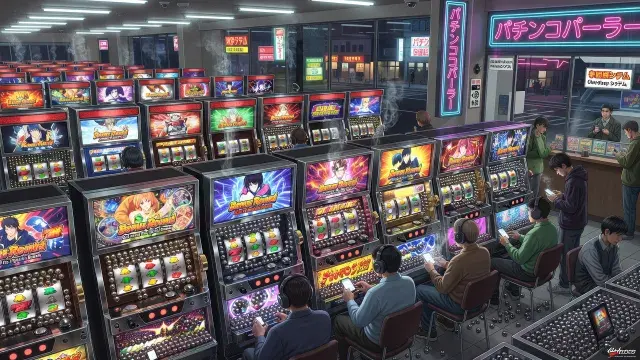
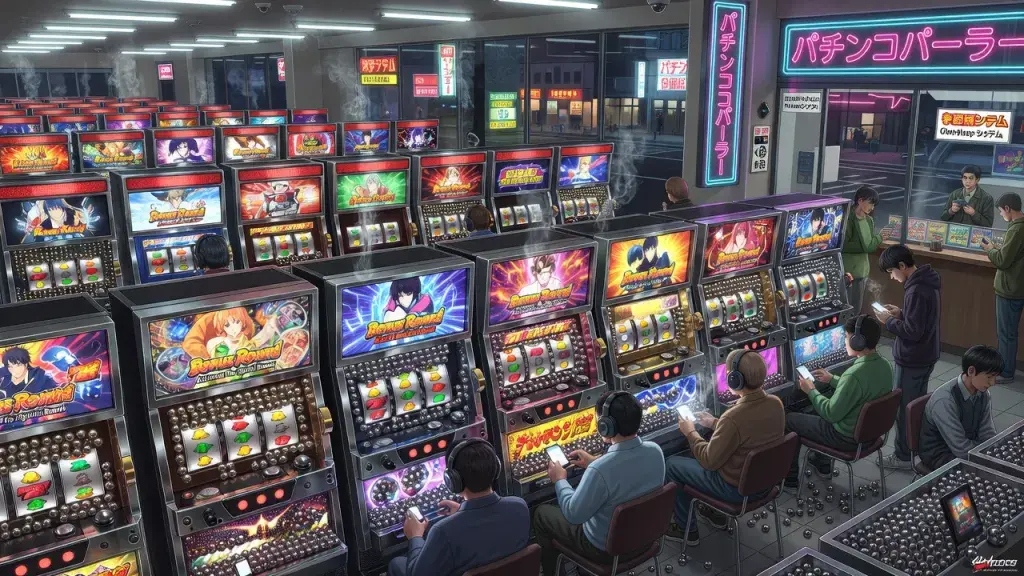
Walking into a pachinko parlor means confronting a wall of sound - hundreds of machines chiming simultaneously, cigarette smoke in older establishments, and rows of players seated in near-silent concentration. Unlike Western casinos, there's little social interaction; players face their machines directly, headphones sometimes on, fully absorbed in the visual sequences unfolding on screen.
Connection to Broader Japanese Arcade Games Culture
Pachinko sits alongside crane games, rhythm machines, and fighting game cabinets as a pillar of Japanese arcade games culture, though it operates in dedicated parlors rather than general arcades. The visual language - bright colors, character licensing, reward animations - borrows heavily from video game design, which explains why pachinko machines increasingly resemble console games more than mechanical pinball.
Generational Shifts in Popularity
Younger Japanese players have shown less interest in pachinko than previous generations, favoring mobile gaming instead. Parlors have responded by incorporating recognizable anime and gaming franchises into machine themes, attempting to bridge the gap between traditional pachinko audiences and younger demographics raised on digital entertainment.
Casino Pachinko and Its Legal Standing
How Casino Pachinko Differs from Traditional Parlors
Outside Japan, the term casino pachinko often refers to pachinko-style machines installed within licensed gambling venues, where direct cash payouts are legal. This removes the need for the three-shop workaround entirely. In jurisdictions with regulated casino floors, pachinko machines sit alongside slots, offering a different rhythm and skill element that appeals to players seeking variety beyond standard reel-spinning games.
Regulatory Differences Across Countries
Japan treats pachinko as amusement with a cash-exchange loophole; other countries treat casino pachinko as straightforward gambling equipment, subject to the same licensing, auditing, and taxation rules as any slot machine. This difference matters for operators and players alike, since machine calibration, payout transparency, and legal protections vary significantly depending on where the game is played.
Integration Into Global Casino Floors
Casino pachinko has found modest footholds in gaming markets across Asia and, more recently, in online-facing platforms that replicate the mechanical feel digitally. Operators market it as a novelty alongside traditional slots, betting that curiosity about Japanese gaming culture will draw players who might otherwise skip past a standard reel machine.
Online Pachinko: Digital Adaptation of a Physical Game
How Online Pachinko Simulates Physical Mechanics
Recreating pachinko digitally means simulating physics - ball trajectory, pin collision, gravity - inside software rather than a physical cabinet. Good online pachinko titles use physics engines to preserve the unpredictable bounce that makes the physical version compelling, while adding faster play speeds and simplified controls suited to a screen and mouse or touchscreen interface.
Differences Between Online and Physical Play
Physical machines involve tactile feedback, ambient parlor noise, and a social-but-solitary atmosphere that online versions can't replicate. In exchange, online pachinko offers accessibility: no travel, no smoke-filled rooms, and the ability to play in short sessions rather than the marathon sittings common in Japanese parlors. Betting increments and pacing also differ, since digital platforms usually let players adjust stakes more freely.
Accessibility for International Players
Online pachinko has effectively exported a Japan-specific hobby to a global audience that would otherwise never encounter it. Players in Europe, North America, and Southeast Asia can now try mechanics that were previously locked behind language barriers, geography, and unfamiliar parlor etiquette, giving pachinko a second life far from its original cultural context.
Choosing the Right Pachinko Platform or Machine
What to Look for in Online Pachinko Sites
Reliable platforms disclose payout structures, use licensed and audited random number generators, and clearly separate demo play from real-money wagering. Watch for transparent terms around withdrawals and bonus conditions, since these details reveal more about a platform's legitimacy than flashy graphics ever will.
Evaluating Physical Machines in Parlors
Experienced players observe a machine's recent activity before playing - how often it's paying out, how full the payout tray looks, and whether staff have recently reset the settings. None of this guarantees a win, but it reduces the odds of sitting down at a machine calibrated for minimal payouts that day.
Safety and Fair Play Considerations
Whether playing casino pachinko in a licensed venue or trying online pachinko from home, checking for proper licensing is non-negotiable. Regulated operators submit to independent auditing of their random number generators, while unlicensed platforms offer no such assurance and little recourse if disputes arise.
Frequently Asked Questions
Is pachinko legal outside Japan?
Legality depends entirely on local gambling laws. In countries with regulated casinos, casino pachinko machines can operate legally with direct cash payouts, while online pachinko availability depends on each jurisdiction's online gambling regulations.
Can you actually win money playing pachinko in Japan?
Yes, indirectly. Players win prize tokens at the parlor, then exchange those tokens for cash at a separate shop nearby, a system that keeps the parlor itself compliant with anti-gambling law while still allowing real payouts.
Does skill matter in a pachinko game, or is it purely luck?
Both factors play a role. Ball physics and reel outcomes are largely chance-driven, but skilled players improve their odds by controlling launch strength precisely and choosing machines based on observed payout behavior.
How is online pachinko different from a slot machine?
Online pachinko simulates a ball-drop mechanic with physical randomness from virtual pins, whereas slots rely purely on spinning reels. The pacing, visual style, and the sense of watching a physical object move set pachinko apart from typical reel-based games.
Why do pachinko machines feature anime characters and video game themes?
Licensing partnerships with entertainment franchises help parlors attract younger players and differentiate machines from competitors. This visual layer connects pachinko to broader Japanese arcade games culture, where character branding and screen-based rewards are standard design elements.
Are online pachinko winnings paid out the same way as in Japanese parlors?
No. Licensed online pachinko platforms outside Japan typically pay winnings directly in cash or site credit, without the token-exchange workaround required by Japanese law, making the process more straightforward for international players.